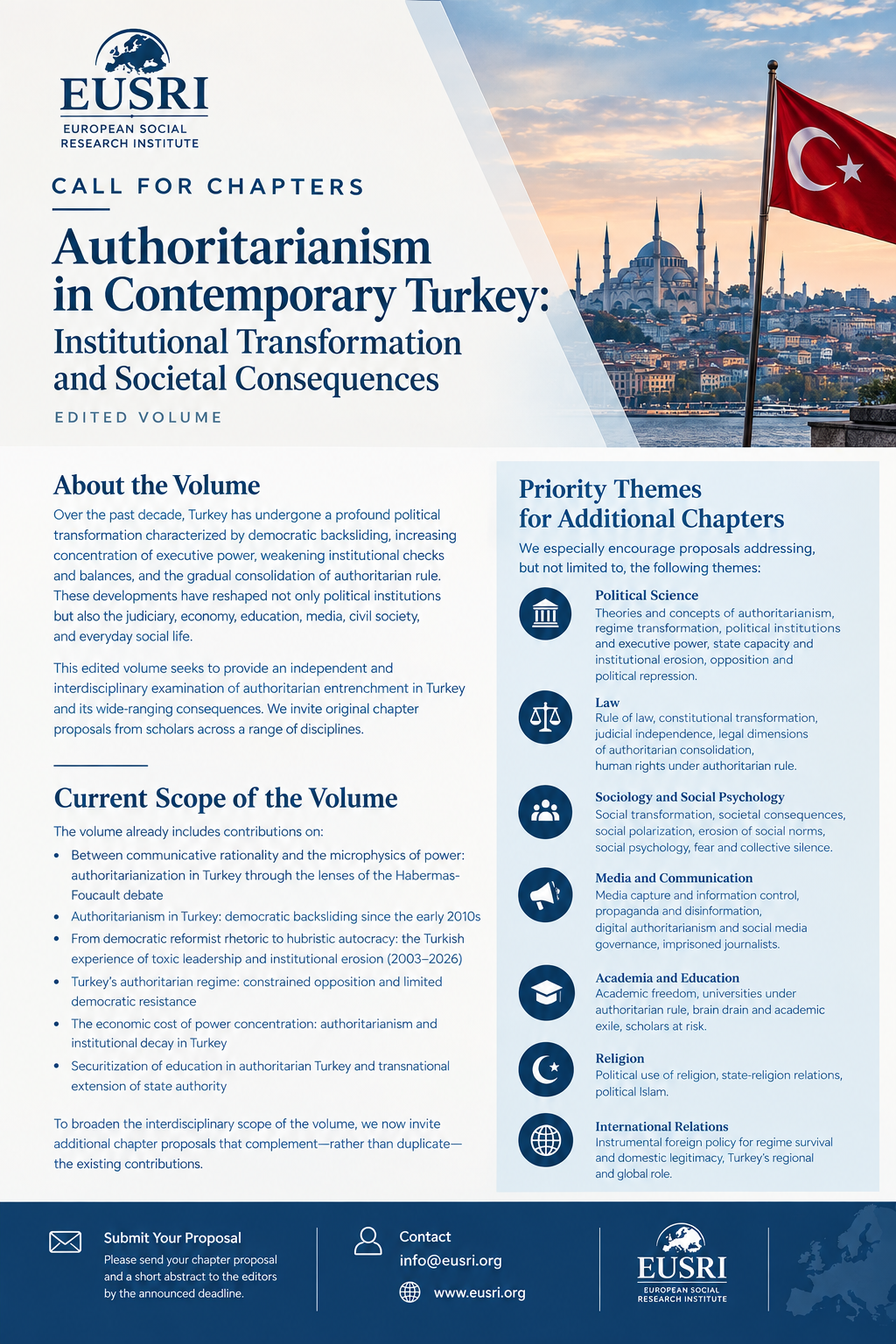
Authoritarianism in Contemporary Turkey: Institutional Transformation and Societal Consequences
About the Volume
Over the past decade, Turkey has undergone a profound political transformation characterized by democratic backsliding, increasing concentration of executive power, weakening institutional checks and balances, and the gradual consolidation of authoritarian rule. These developments have reshaped not only political institutions but also the judiciary, economy, education, media, civil society, and everyday social life.
While a substantial body of research has emerged, much of the academic production inside Turkey has been constrained by increasing political pressure, institutional dependence, self-censorship, and restrictions on academic freedom. At the same time, many scholars who have continued researching these issues now live outside Turkey after forced displacement or exile.
This edited volume seeks to provide an independent and interdisciplinary examination of authoritarian entrenchment in Turkey and its wide-ranging consequences. Rather than focusing solely on political institutions, the volume aims to explore how authoritarian governance transforms society, law, economy, education, media, political culture, and international relations.
The book also aims to contribute to the broader comparative literature on democratic backsliding, authoritarian entrenchment, and state transformation by situating the Turkish experience within contemporary theoretical debates.
Our objective is to produce a comprehensive scholarly volume that will serve as a valuable resource for researchers and readers interested in understanding contemporary Turkey beyond official narratives. Target audience are scholars and students of comparative politics, Turkish politics, authoritarianism, democratization, sociology, law, and international relations, as well as policy analysts, journalists, and general readers seeking an academically rigorous understanding of Turkey’s authoritarian transformation and its broader implications.
We invite original chapter proposals from scholars working in political science, sociology, law, international relations, (social) psychology, education, history, media studies, and related disciplines.
Current Scope of the Volume
The volume has already secured contributions covering several core dimensions of authoritarian entrenchment in Turkey, including:
Between communicative rationality and the microphysics of power: authoritarianization in Turkey through the lenses of the Habermas-Foucault debate
Authoritarianism in Turkey: democratic backsliding since the early 2010s;
From democratic reformist rhetoric to hubristic autocracy: the Turkish experience of toxic leadership and institutional erosion (2003-2026);
Turkey’s authoritarian regime: constrained opposition and limited democratic resistance
The economic cost of power concentration: authoritarianism and institutional decay in Turkey;
Securitization of education in authoritarian Turkey and transnational extension of state authority.
To broaden the interdisciplinary scope of the volume and provide a more comprehensive understanding of authoritarianism in Turkey, we are now inviting additional chapter proposals that complement—rather than duplicate—the existing contributions.
We particularly welcome contributions that examine dimensions of authoritarian rule that remain underexplored in the current volume.
We welcome both single-authored and co-authored chapter proposals, with a maximum of two authors per chapter.
Priority Themes for Additional Chapters
We especially encourage proposals addressing, but not limited to, the following themes:
Poltical Science: theories and concepts of authoritarianism, regime transformation, political institutions and executive power, state capacity and institutional erosion, opposition and political repression
Law: rule of law, constitutional transformation, judicial independence, legal dimensions of authoritarian consolidation, human rights under authoritarian rule
Sociology and Social Psychology: social transformation in authoritarian Turkey, societal consequences of authoritarian rule, social polarization, the erosion of social norms, social psychology, fear and collective silence
Media and communication: media capture and information control, propaganda and disinformation, digital authoritarianism and social media governance, imprisoned journalists
Academia and education: academic freedom, universities under authoritarian rule, brain drain and academic exile, scholars at risk
Religion: political use of religion, state-religion relations, political Islam
International relations: instrumental foreign policy for regime survival and domestic legitimation
Behavioral Science and Leadership: political leadership and decision-making, authoritarian leadership styles, political psychology, political attitudes and public opinion, obedience and conformity, political participation, leadership and regime resilience
Other interdisciplinary proposals relevant to the volume’s overall theme are also welcome.
Methodological Approach
The volume welcomes contributions employing a range of approaches, including literature-based research, theoretical and conceptual analysis, and systematic analysis of political, socio-economic, legal, and societal developments in Turkey. Chapters may also draw on relevant case studies, documentary sources, and existing empirical research. Regardless of approach, contributions should engage with relevant scholarship and offer a clear and well-supported analysis of the processes and consequences of Turkey’s political and social transformation.
Submission Guidelines
Please submit: an abstract of 250–300 words; five keywords; a short biography (100–150 words).
Selected authors will be invited to submit full chapters of approximately 8,000–9,000 words including references (main text: Times New Roman, 12 pt, 1.5 line spacing).
All submissions will undergo editorial review. Final chapters may also be subject to external peer review depending on the publisher’s requirements.
Important Dates
Abstract / short biography submission: December 15, 2026
Notification of acceptance: December 30, 2026
Full chapter submission: February 15, 2027
Revised chapter submission: March 1, 2027
Please send abstracts to: info@eusri.org